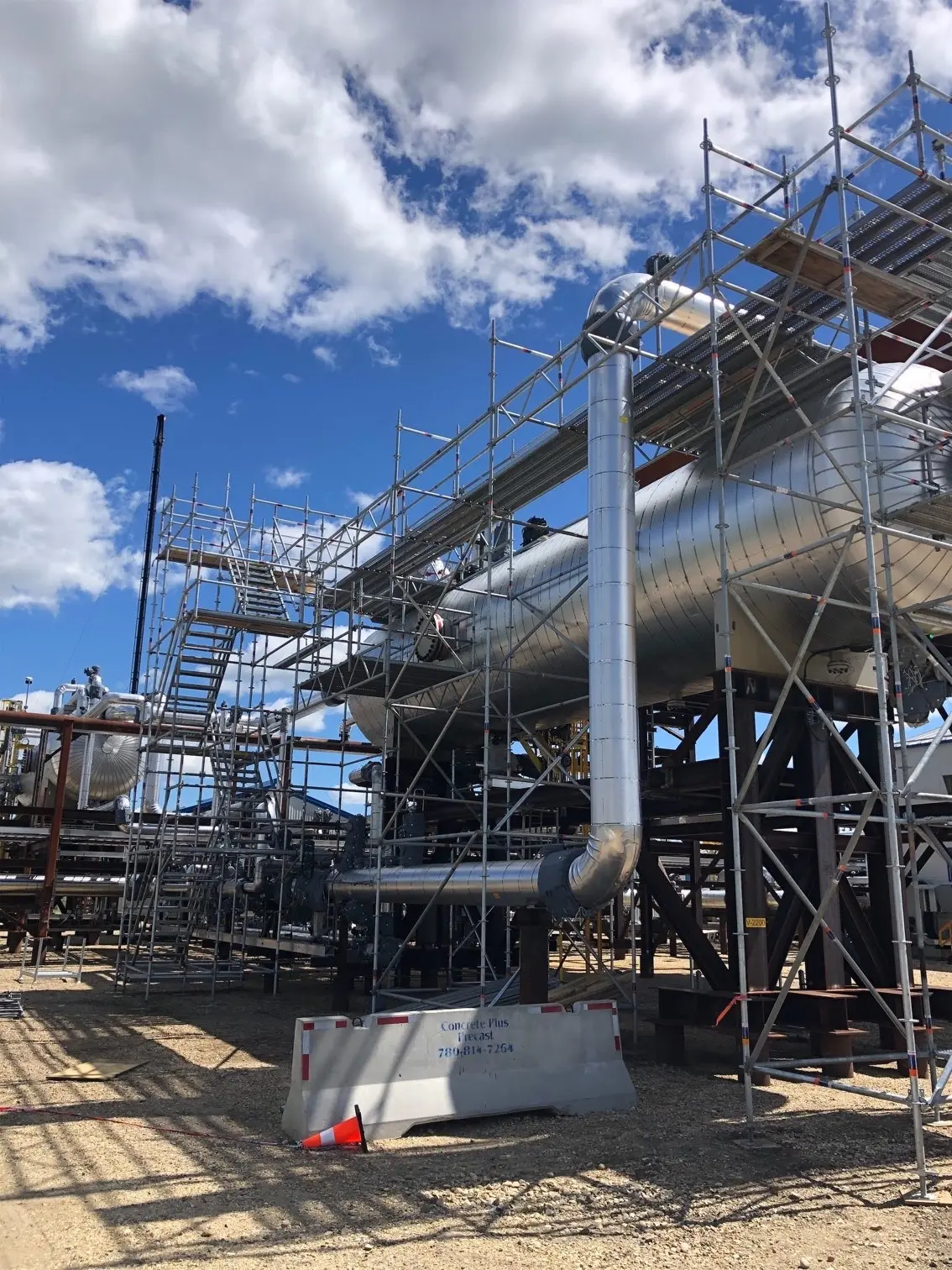
A turnaround at a gas processing facility rarely runs on a comfortable timeline. Crews show up with a fixed shutdown window, a full work scope, and zero tolerance for delays that push the plant past its restart date. Before a welder, insulator, or NDT technician can reach the work, somebody has to build the access. That is where the entire schedule either holds together or starts unraveling. In oil and gas environments, scaffolding sits directly on the critical path. Late access means every downstream contractor sits idle. Poor builds slow the work and raise the safety risk.
Access Decides the Schedule on Every Oilfield Project
Across Western Canada, owners and EPCs treat industrial scaffolding services as a critical path item, not a side trade. Whether the job is a refinery turnaround, a gas plant tie-in, or routine maintenance on a tank farm, the access has to be ready before the trades arrive. Rushing the build later costs many times more than planning it correctly the first time. Anyone can rent frames. Far fewer crews can coordinate with operations, work around live equipment, and deliver a structure that holds up to inspection on day one.
What Makes Scaffolding So Demanding in Oil & Gas Environments?
At G&R Insulating, the conditions are unforgiving. Crews work at height, around hot piping, near classified zones, in cold weather, and inside congested process units where every column, valve, and instrument matters. A generic build does not fit. The crew has to engineer around the equipment instead of dictating to it. There are also permitting layers, hot work coordination, confined space tie-ins, and regulatory expectations from provincial OHS and energy regulators. For G&R Insulating, industrial scaffolding in this sector has to clear all of that before a single brace goes up.
Scaffolding Planning and Building Services
Most failures on site trace back to weak planning. At G&R, we treat planning as a real discipline because it directly determines how the rest of the job runs.
Site Walks and Scope Confirmation
Our team walks the area with the client, verifies the scope, and notes access challenges in person before any pricing goes out.
Engineered Drawings and Load Calculations
Cantilevers, suspended decks, and hanging access around vessels need engineered drawings stamped by a professional engineer. We organize that documentation early so approvals do not stall the schedule.
Material Staging and Team Sequencing
We pre-stage materials based on build order, not just totals, so the crew is moving instead of searching.
Coordination with other trades
Insulators, pipefitters, electricians, and inspectors all need access at different times. Our supervisors map those dependencies so the scaffold supports the broader plan.
Modification and Dismantling Planning
Large projects almost always need mid-build modifications. We plan those reconfigurations and the dismantle phase the same way we plan the build.
Working with Experienced Oilfield Scaffolding Contractors
Choosing the right team is less about hourly rates and more about how the contractor performs under pressure. Experienced oilfield scaffolding contractors arrive with their own safety program, a trained tagging system, and supervisors who can read a P&ID without constant escorting.
In our work across Alberta, Saskatchewan, and BC, projects run more smoothly when the scaffold partner already knows the client’s permit-to-work process and isolation procedures. Operators increasingly tie their preferred industrial scaffolding contracts to long-term safety performance and turnaround reliability rather than spot pricing.
Types of Scaffolding in the Construction Industry Used Across Oilfield Work
Different jobs need different systems. Oil and gas projects pull from several configurations depending on geometry, load, and access.
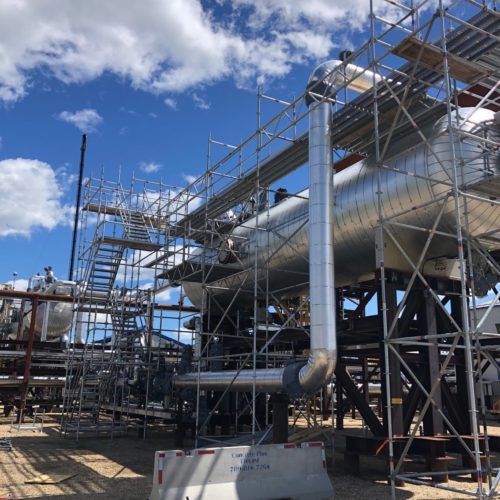
- Tube and clamp scaffolding for irregular vessels and process units where standard frames will not fit
- System scaffolding, such as ringlock and cuplock, for tank exteriors and structural steel, where speed of erection matters
- Suspended and hung scaffolds for tall vessel internals, flare stacks, and overhead piping
- Cantilevered platforms for work over live process areas where ground columns are not an option
- Mobile towers for short-cycle inspection, painting, and minor maintenance
Why Operators Lean on Specialized Industrial Scaffolding Services
Generic scaffold rentals do not survive in the energy sector. The combination of regulatory load, schedule pressure, and operational hazard means clients need industrial scaffolding services that operate as a discipline rather than a commodity. Specialists keep certified crews on the payroll, maintain a dedicated equipment fleet, and run their own safety statistics so EPCs can vet them properly during pre-qualification.
Integrated Scaffolding and Insulation Support
A real advantage shows up when the same provider handles both access and insulation. We, at G&R Insulating and Scaffolding, built our capability around that integration. Combining industrial scaffolding with mechanical insulation under one roof removes a coordination layer for the client and keeps oil and gas schedules tight.
Plan Your Next Project with Reliable Industrial Scaffolding Services
Our team is ready to mobilize quickly, plan thoroughly, and deliver industrial scaffolding services that hold up to inspection and keep your project on schedule. Reach out to G&R Insulating and Scaffolding to book a site visit or request an estimate for your next turnaround.